
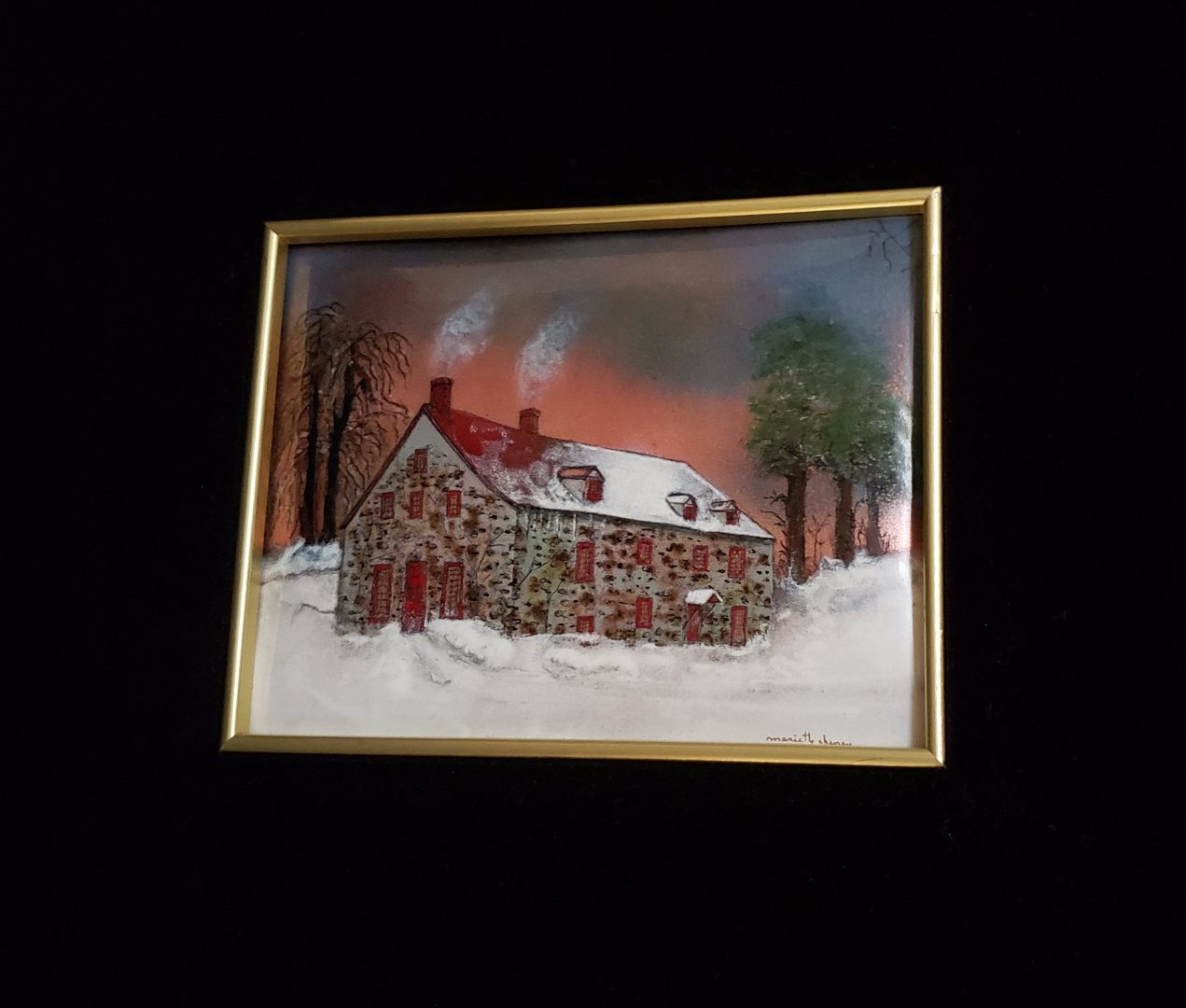
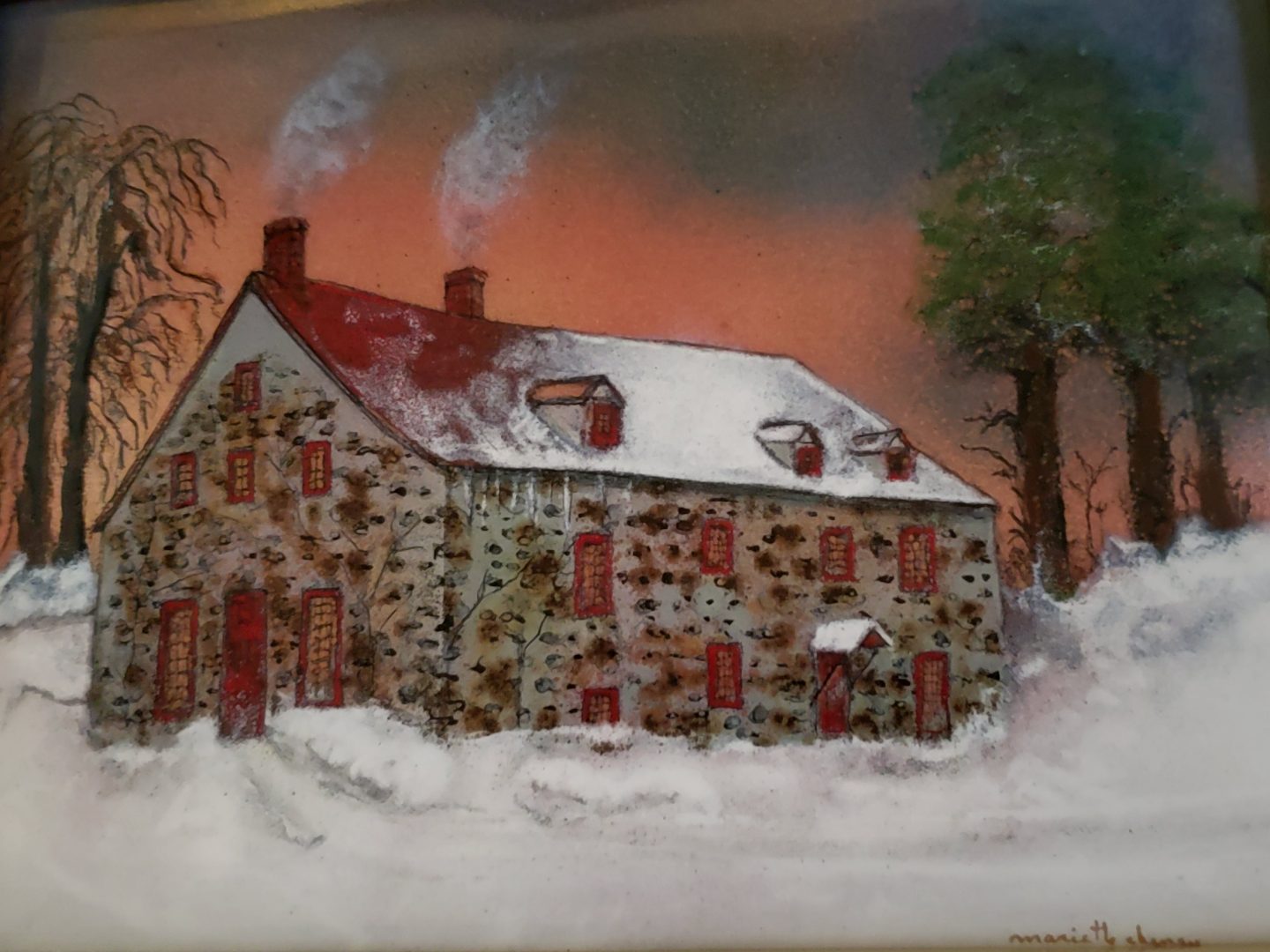
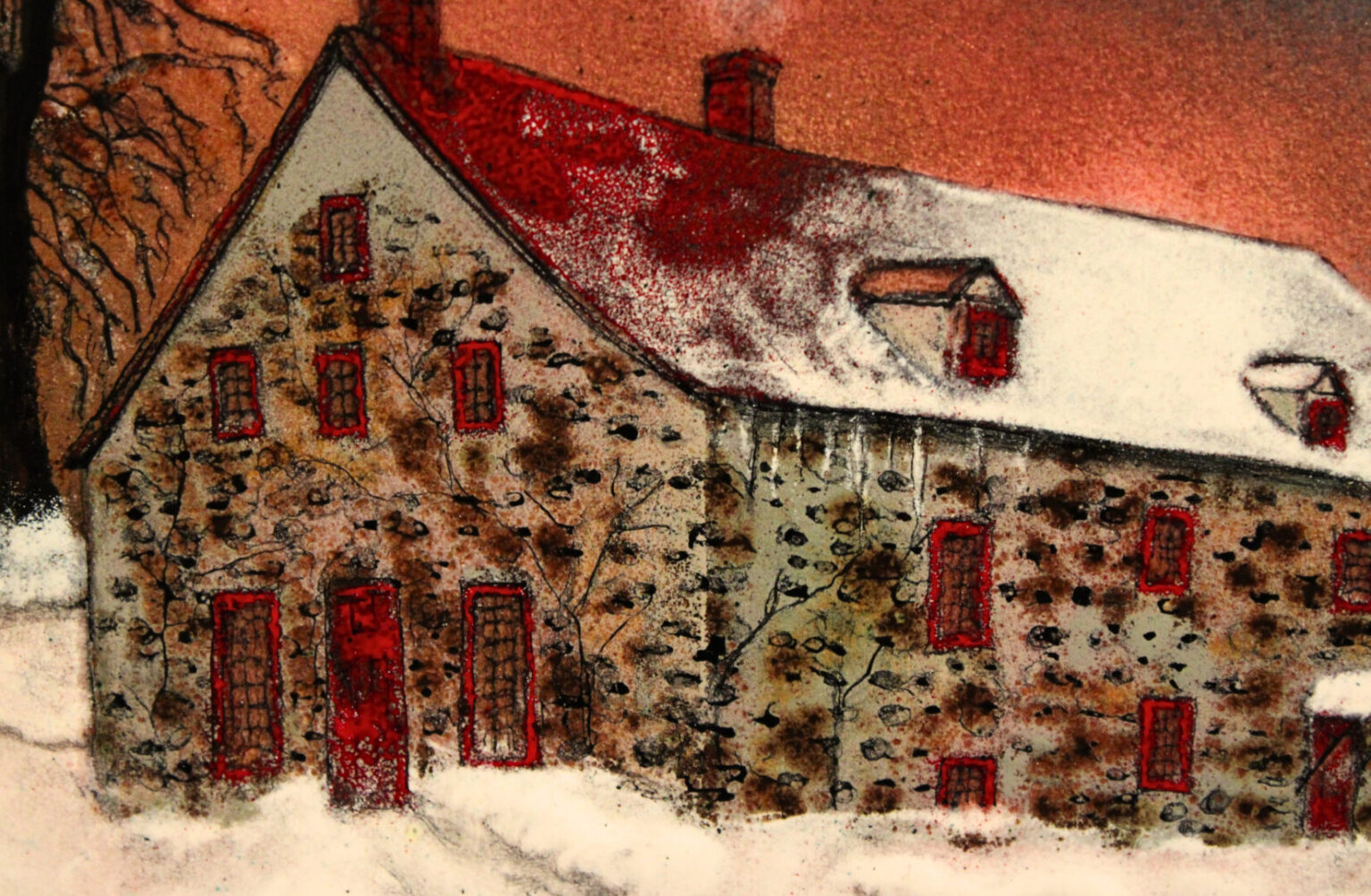
The mill depicted on this enamel on copper is the restored version of the second flour mill powered by the water of the Saint-Charles River and built in Pointe-du-Lac, a suburb of Trois-Rivières. This enamel on copper is highlighted in a frame made from a metal moulding and a black velvet Marie-Louise.
A first mill was built by René Godefroy de Tonnancour (1669-1738). The one illustrated here, which replaced the first mill, was built between 1765 and 1788 by Louis-Joseph Godefroy de Tonnancour (1712-1784), René’s son.
The flour mill remained the property of the Godefroy de Tonnancour family; it was then passed down to Thomas Coffin through his marriage to Marguerite Godefroy de Tonnancour, Louis-Joseph’s daughter, until 1795, when Nicolas (Nicholas) Montour (1756-1808) acquired it. After Montour’s death, his wife, Geneviève Mills, who lived in Quebec City, decided to come settle in Pointe-du-Lac around 1810. She remained the owner of the mill until her death in 1832. The seigneury and its mill passed down to her daughter, Julie-Éliza Montour, then to her son-in-law, Charles-Christophe Malhiot (1808-1874), a physician, upon Julie’s death in 1865.
In the late 19th century, the site developed; other businesses, workshops, and small factories were established in the surrounding area. The village expanded.
In 1927, the mill was sold to the Brothers of Christian Instruction, who had lived on the estate since 1911. The mill ceased its operations in the early 1960s.
In 1973, we witnessed the establishment of the Corporation du Moulin seigneurial de Pointe-du-Lac inc., which aimed to renovate the mill and hold educational and tourist activities there. Major restorations to the mill were carried out between 1978 and 1980 at costs exceeding $350,000.
Although the Minister of Cultural Affairs classified the mill in 1975, the entire complex that once made up this industrial site from the 18th and 19th centuries was not officially duly classified until 2006.
As for the artist, Mariette Cheney, she was born in Cap-de-la-Madeleine around 1923 to a large family. From a very young age, she was attracted to art in all its forms: music, sculpture, theatre, drawing, etc.
When she was introduced to enamel art, among others by Thérèse Brassard, Mariette Cheney was seduced by this medium. For her, this art became a means of expression that allowed her to combine talent and sensitivity, intensity and dynamism, as well as meticulousness and creativity.
Her links with the Tonnancour mill were forged when she received permission from the Brothers to settle permanently in the miller’s dwelling. She moved out of her apartment on rue Bonaventure, located in downtown Trois-Rivières, and sold her furniture to earn some money to pay the workers that she hired to renovate—at least a little—the dwelling that had been abandoned for nearly 15 years.
In 1973, she began this new life as the “lady” of the premises. In reality, the corporation entrusted her with the mandate of director of the seigneurial mill, a position that she held until 1988. She nevertheless continued to live in the mill until, shortly before her death, hospitalization forced her to leave it. She died in early March 2013.
Musée Pierre-Boucher Collection
1987 1034 P

Some piece offers
a narration of the descriptive
texts;
The work description
is set at a fixed height.
You can scroll down
at any time to
see more.
Some pieces have more
than one image. Click on the arrows
to scroll through them.
Navigate between works
using the "previous"
and "next" buttons
You can also consult
the pieces contained
in a room in a grid.
