
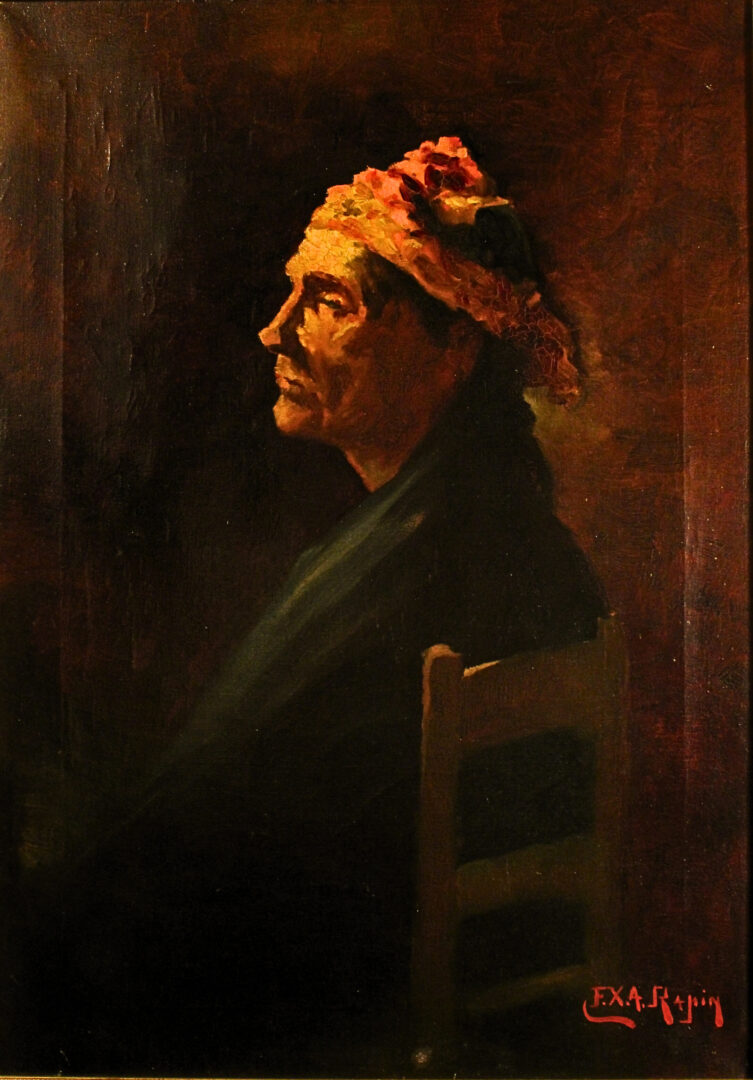
This work depicts a person in profile. This individual which could be an old man or an old woman is sitting on a wooden chair. Pared with a scarf/turban on his/her head in shades of ochre and orange-pink, resting slightly on his/her forehead and tied in the back of his/her head, this person is dressed with very dark clothing. The only part in the light is his/her face.
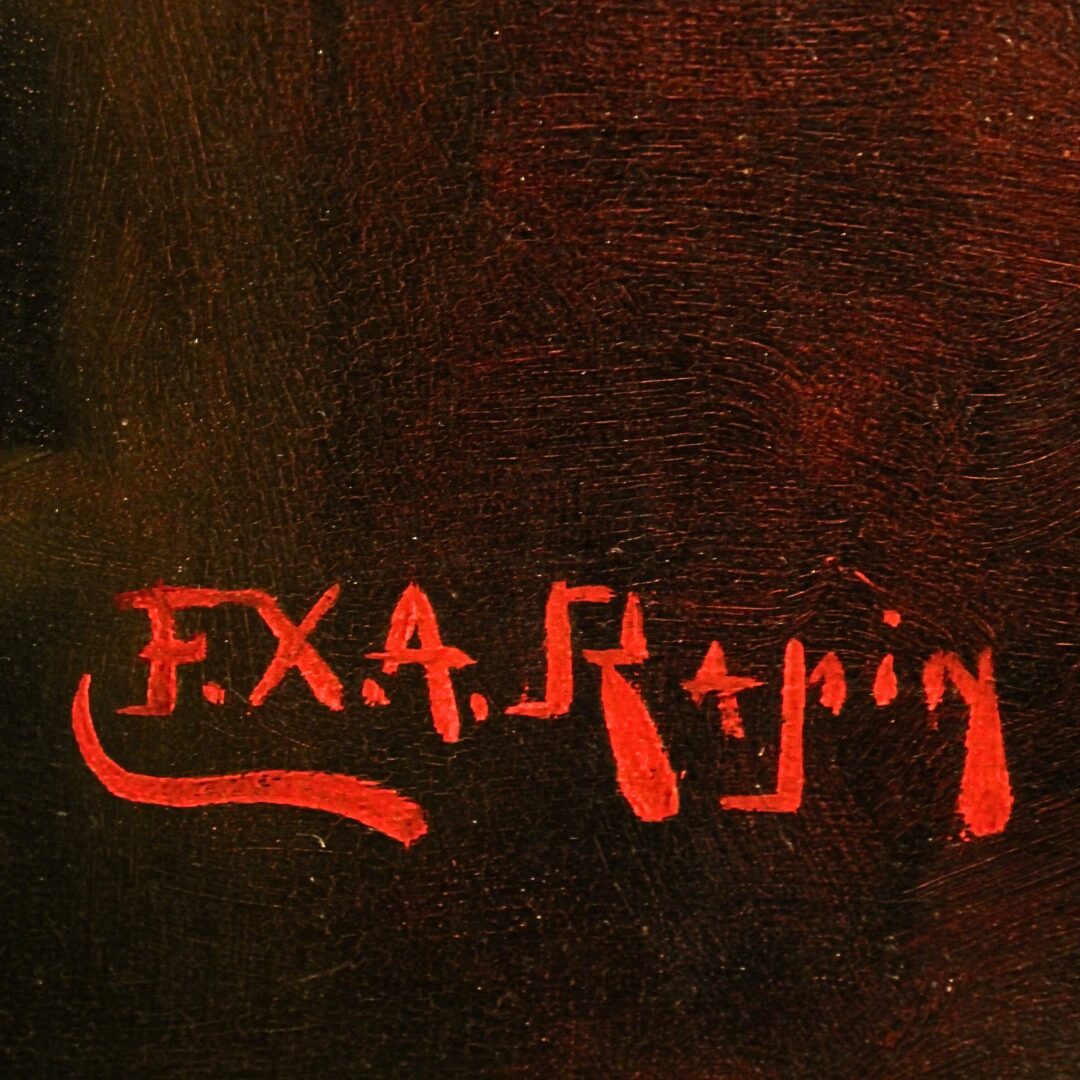
As for the artist, François-Xavier-Aldéric Rapin, he was a native of Saint-Timothée (now Salaberry-de-Valleyfield) in Beauharnois County, in Quebec. He was born on October 25, 1868, and baptized the following day under the first name of Uldéric. He was the son of François-Xavier Rapin, an innkeeper, and Rachelle Bourdon. At his birth, he already had two brothers and six sisters. A seventh sister, Graziella, would be born the following year.
In 1891, he lived in Montreal East in the Saint-Antoine neighbourhood with his mother, a widow, and the youngest in the family, a milliner. He left for two years to continue his studies at the École des Beaux-Arts de Paris. When he returned, Rapin married Léonie Rodrigue. A drawing teacher at the Conseil des arts et manufactures de Montréal in 1893-1894 and the Académie Saint-Jean-Baptiste in 1894-1895, he later taught drawing and painting in Marieville. He is the creator of a Self-Portrait and The Communicant, a work reproduced in Le Monde illustré (Montreal) on April 28, 1900. He also painted The Clearing.
Admitted to the Hôtel-Dieu de Montréal in April 1901, Rapin died there one month later. He was buried on May 20 in his native village.
Despite a career that was cut too short, he made a name for himself as a genre painter, landscape painter, decorator, drawer, and portraitist.
The Musée national des Beaux-Arts du Québec owns two works by this artist, including My Room in Paris.
Donation from Yves Lamonde
Musée Pierre-Boucher Collection
1987 979 P

Some piece offers
a narration of the descriptive
texts;
The work description
is set at a fixed height.
You can scroll down
at any time to
see more.
Some pieces have more
than one image. Click on the arrows
to scroll through them.
Navigate between works
using the "previous"
and "next" buttons
You can also consult
the pieces contained
in a room in a grid.
